increase in unique prospective-student interactions at each Open Day, versus 2014 Twitter activities
Case study / UEA / 2015–2016
A more personal way to connect.
How I introduced WhatsApp to the University of East Anglia's Open Day communications — and helped turn a one-day event into an ongoing conversation with prospective students.
Explore the case study ↓~200%more unique prospective students interacting at each 2015 Open Day than through our 2014 Twitter activities
A clear comparison, not a conversion claim. This result was reported in my contemporary interview with Pickle Jar Communications. It compares interactions across different channels and years, not confirmed enrolments.
01 / The challenge
Useful conversations shouldn't stop when an Open Day ends.
As Social Media Coordinator at the University of East Anglia, I wanted to rethink how we stayed in touch with prospective students. Twitter and Storify had worked well for sharing Open Day experiences, but public hashtags were not always the right setting for questions about applications, accommodation and university life.
I wanted a channel that made it easier to ask questions privately and continue conversations beyond a single event, throughout the applicant cycle.
02 / The idea
Bring the conversation to students.
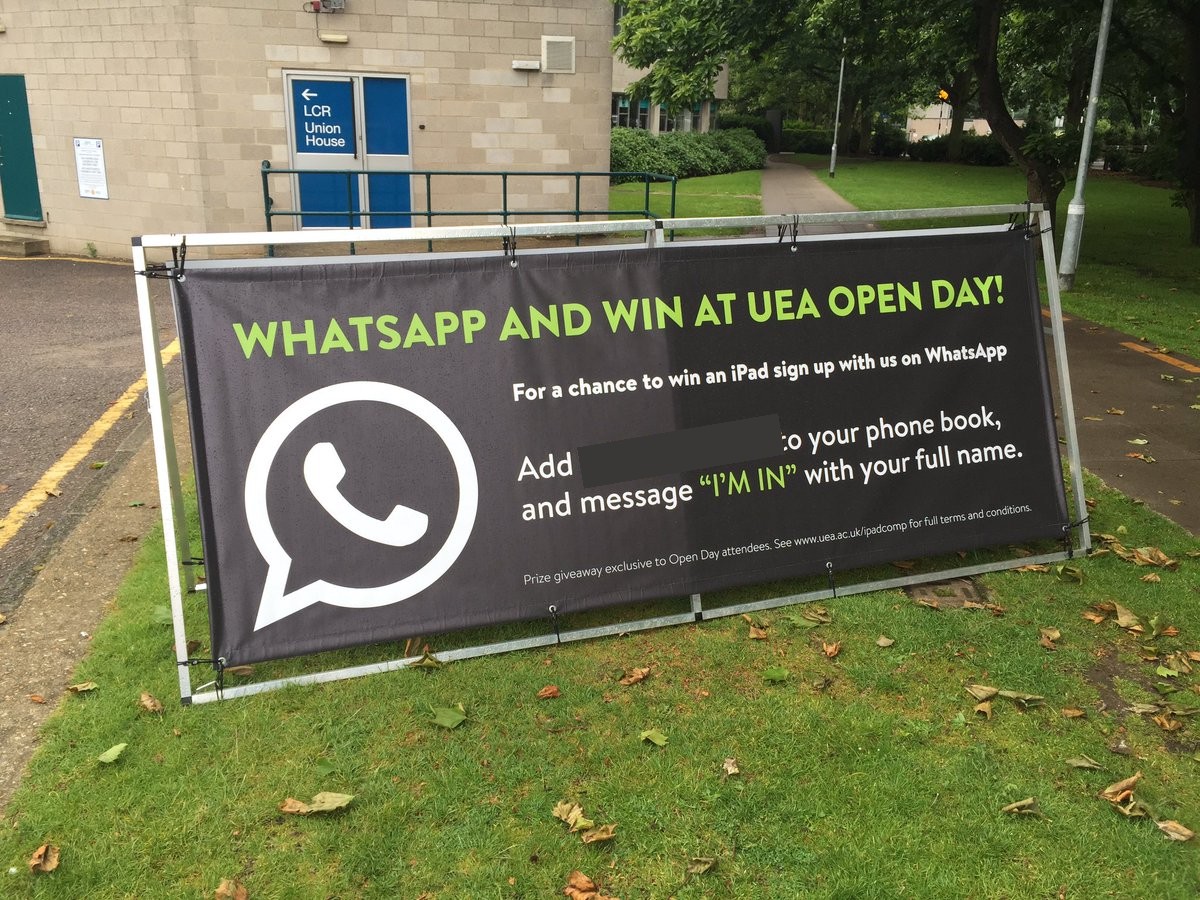
In spring 2015, I introduced WhatsApp as a new way for UEA to communicate with Open Day visitors. Students could sign up in advance, send individual questions, receive updates and take part in interactive activities during their visits.
Instead of treating WhatsApp as another broadcast feed, I used it for direct, two-way conversations. My experience as a UEA graduate helped me answer questions with a personal understanding of the university. We retained Twitter as a parallel, public channel for wider audiences.
03 / The results~200% Hundreds Beyond the day
From an experiment to a meaningful channel.
of messages received in the opening hours of busy Open Days
conversations continued about courses, applications and accommodation
In my published account, I described feedback calling the service a clever and unique addition to Open Days. Some weeks, WhatsApp generated more prospective-student enquiries than UEA's other social channels. These are historical observations, rather than independently audited conversion figures.
04 / What I learned
Innovation needs a workable operation behind it.
The technology was simple for students, but the operation was labour-intensive. At the time, WhatsApp offered limited integrations with customer-relationship management tools. Managing opt-ins, incoming enquiries and ongoing contact required careful planning and resources.
The experience reinforced a lesson that has guided my work ever since: choosing the newest platform matters less than understanding the audience, testing a useful approach and investing in the capacity to sustain it.
In my own words
Sharing what we learned with the sector.
I discussed the project in “WhatsApp in higher education: a UEA case study”, published by Pickle Jar Communications, covering our original aims, results and practical advice for other universities considering messaging apps. Read the original Pickle Jar case study ↗
Source: Pickle Jar Communications, original interview with Jono Read, Social Media Coordinator at UEA. Performance figures and project descriptions on this page are drawn from that account and my contemporary UEA planning review.